
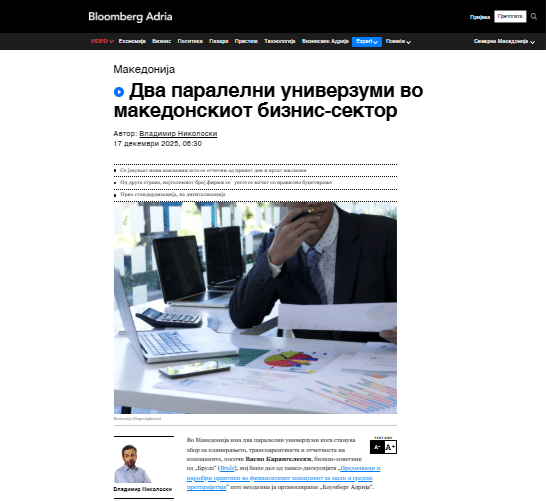
Brulz was part of the panel discussion “Challenges and best practices in financial management for SME’s” organized by Bloomberg Adria in December 2025.
As part of the discussion, Vasko Karangeleski from Brulz has been featured in an article in Macedonian: Two parallel universes in the Macedonian business sector
The key points in the article on Two parallel universies in the Macedonian business sector are:
- New companies are emerging that are accountable from day one and turn over millions.
- While other companies still struggle with proper budgeting.
- First there must be standardization, then we can talk about digital transformation.
The parallel business universes in the country are related to the statement:
“On the one hand, new companies are being formed that are mostly software and service-based and that are transparent from the first day they are established. We have examples of such companies that in less than two years reached 10 million euros in annual turnover. On the other hand, in 90 percent of companies, they do not control and plan the management of working capital at all.”
On market limitations, Karangeleski was quoted:
“We should keep in mind that in 2024, more than 15 industries will have an average waiting time of more than a hundred days for debt collection. Apart from such ‘external’ liquidity problems, such as collection time, limited access to finance, etc., I believe that a major problem for us is the size of the market. We have a limited market, and our medium-sized companies are small in a broader context.”
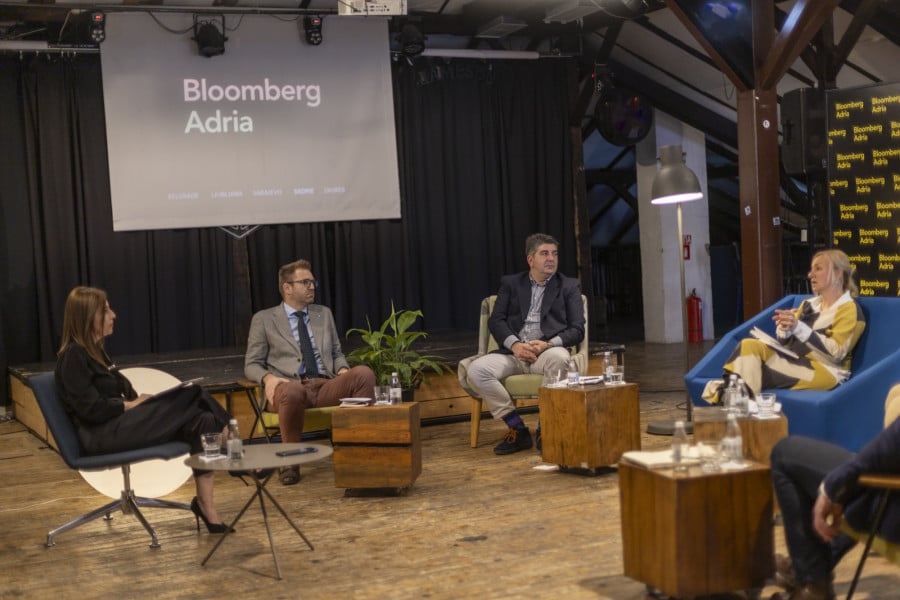
Photo by Bloomberg Adria
On digitalization and digital tools impact on SMEs, he has stated:
“In terms of cost structure, we had an example of offering a service provided by a part-time employee and with automation that costs as much as paying one person per year. The same job until three years ago required four full-time employees. Digital tools are very accessible and, when it comes to the question of whether they are expensive or cheap, it must be taken into account that today there are software tools that can easily replace ERP and, from a financial management perspective, would not be considered as an initial capital investment but as a direct variable cost, which we can have as long as we need it and change it next month,”
The fact is that digital tools are needed to ensure transparency and timely decisions, to enter new markets, to measure performance according to selected indicators”, Vasko has been quoted.
But digitalization by any means is not supported, stating the BRULZ approach in going for it: “not a supporter of the thesis that everything must be digitalized, but that things, i.e. processes, should first be set up well, then standardized, and only then automated, i.e. digitalized.”
Read the full article (in Macedonian) on the Bloomberg Adria page
Five business advisors debated the challenges and problems in financial management in small and medium-sized enterprises within the framework of the round table “Not so small talks” . One of the main conclusions from the debate was that the business sector has energy, ambition and ideas, but often lacks the capacity and knowledge to make reliable analyses and, consequently, to establish mechanisms that will be a kind of roadmap for sustainable growth of companies. The activity is supported within the framework of the Swiss Modernization Project implemented by Swisscontact.