
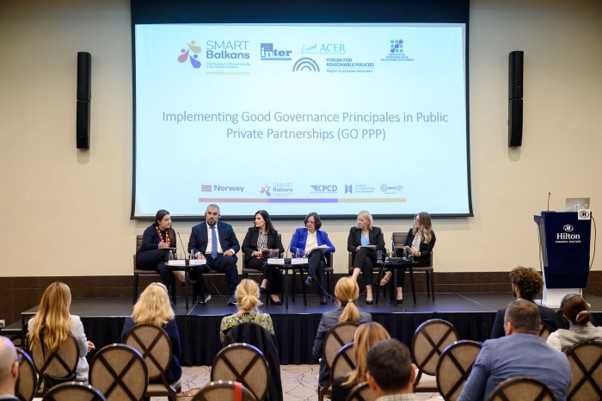
The Findings of the study on Public Private Partnership – PPP in North Macedonia were presented by Vasko Karangeleski, BRULZ, author of the study and policy paper in May 2025. The regional conference in Podgorica was a part of the project “Implementing Good Governance Principles in Public-Private Partnership Projects (GO PPP).” Week earlier in Skopje, BRULZ presented the policy brief and sharing insights on how to improve national policy frameworks, to decision makers, public and private sector representatives and civil society from Serbia, Montenegro, Albania and North Macedonia, withing the
On 27 May 2025, public officials, experts and civil society organisations from Serbia, Montenegro, Albania and North Macedonia met at the Hilton in Podgorica for the Regional Conference on Public-Private Partnerships: Strengthening Regional Cooperation. The conference was part of the GO PPP project (Implementing Good Governance Principles in PPP Projects), supported by the Kingdom of Norway through the SMART Balkans programme and led by the Institute for Territorial Economic Development (InTER). BRULZ took part as the PPP expert for North Macedonia, working with the Forum for Reasonable Policies, the project’s North Macedonian partner.
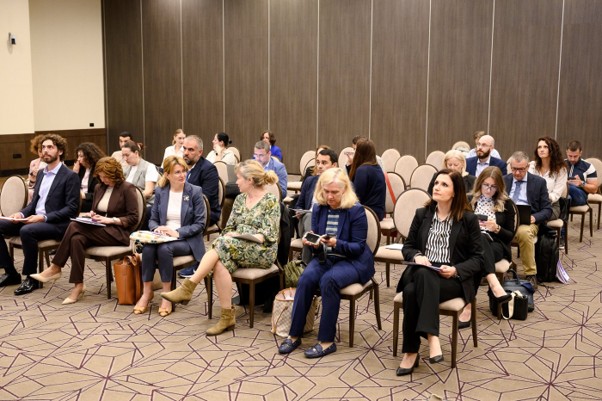
North Macedonia Well Represented
The event was opened by Dr Vesela Vlašković of InTER, H.E. Kristin Melsom, Ambassador of Norway to Serbia, Montenegro and North Macedonia, and Sava Ivanović of IPER. The ambassador set the tone: PPPs are powerful tools for sustainable development, but only when they are designed with integrity, accountability and the interests of citizens in mind.
North Macedonia was well represented. In the first session, on the state of PPPs in the Western Balkans, Andrijana Stojanovska, State Advisor for Regional Development at the Ministry of Local Self-Government, pointed to gaps in human and financial resources and specialist knowledge at local level. She named energy-efficient street lighting as the country’s most successful PPP model and called for more transparent procedures and monitoring throughout implementation. Liljana Naskova, PPP and concessions advisor at the Ministry of Energy, Mining and Mineral Resources, reported that the new PPP Law, aligned with EU directives, was awaiting government approval. In the second session, Renata Kostovska, who is responsible for the national PPP register, joined colleagues from Albania, Serbia and Montenegro to discuss how PPP projects are designed, financed and delivered.
BRULZ on the case-study panel
In the third session, on lessons learned from PPP implementation in the region, Vasko Karangeleski of BRULZ presented findings from the study of the PPP framework in North Macedonia and the related policy paper. He presented the recently prepared study, and shared experience from conducted feasibility studies for PPPs in healthcare, elder care, road infrastructure and public administration buildings. One of them being one of the first PPPs implemented in the country.
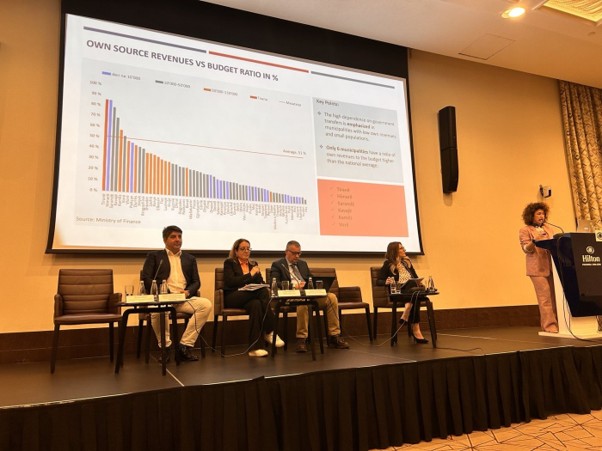
He opened with a story from a regional training for public servants, where a deputy minister summed up the region’s dilemma: “Now I understand why we are lacking development. We want public services and public benefits like Norway, but we have a GDP per capita like an African country.”
PPPs, he argued, are one way to close that gap when budgets and institutional capacity are limited. His central topic was the stage the countries in the region are in, still at the stage of noticing symptoms: delays, failed contracts, accusations towards public officials. North Macedonia, he suggested, has moved on to diagnosis and treatment. A new PPP Law is coming, the PPP register is being renewed, and the debate is shifting from how many PPPs are signed each year to whether they are sustainable.
BRULZ made three points:
- Measure success properly. Count sustainable outcomes and value for citizens, not just the number of contracts or the size of investments.
- Separate PPPs from concessions. Mixing concessions of public goods with PPPs is one of the biggest risks in the region. The new law’s separation of the two is a step forward.
- Treat the private partner as a partner. The private partner brings finance and efficiency and needs a fair return. Without that, the service would not exist at all. PPPs work when they are built on that balance, not on the public side’s position of power.
The discussions confirmed what our North Macedonia study found: the legal frameworks largely exist, but results depend on implementation, institutional capacity, trust between partners and transparency towards citizens.
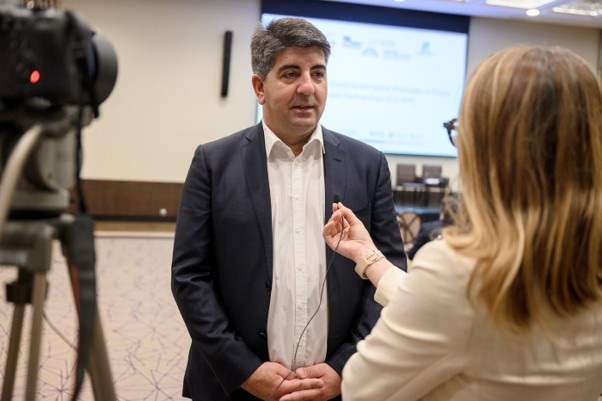
Montenegrin media covered the conference widely:
The conference closed with formal steps towards a Regional PPP Community, a network of decision makers, public and private sector representatives and civil society from the four countries.
Improving PPPs in North Macedonia: Policy Brief Presented in Skopje
BRULZ presented the policy brief “Improving Public-Private Partnership in North Macedonia”, written by BRULZ, to Macedonian stakeholders and regional colleagues. The Policy brief is available in Macedonian.
What the policy brief says
The brief turns our full study of the PPP framework into a short document for decision makers. Its starting point is simple: PPPs have been used in North Macedonia for almost two decades, but the country has not yet aligned its legal and institutional framework with EU Directive 2014/23/EU, and that limits what PPPs can deliver.
The numbers show where PPPs are actually happening. We identified 68 PPP contracts, while the official register lists only 62. About 79% have a municipality or municipal enterprise as the public partner. Energy-efficient street lighting remains the most successful model: municipalities get modern systems with no upfront cost and a predictable, easy-to-budget bill.
The brief groups the obstacles into four areas:
- Transparency: there is no complete public database of PPP projects, their status and fee structures, and historical data on the services being outsourced is hard to find.
- Politics: rules and responsibilities change, support for long-term contracts is uncertain beyond election cycles, and there is no national PPP strategy.
- Capacity: public partners, especially municipalities, lack specialist knowledge and tools to monitor contracts. The national PPP Council has not met in eight years.
- Complexity: preparation takes a long time for complex projects, and different contract forms create different expectations.
The brief closes with six sets of recommendations:
- Align with European standards: restart the new PPP Law and separate PPPs from extraction rights.
- Regulatory and institutional framework: give the PPP Council a real role in strategy, adopt a national PPP policy within public investment management, and pre-select projects at the planning stage.
- Capacity building: strengthen the Ministry of Economy and Labour as lead institution, involve the Ministry of Finance early, and support municipalities and civil society partners.
- Monitoring and measurement: introduce manuals, benchmarking, annual reporting, performance reporting for each project, and fiscal risk management.
- Awareness and promotion: publish every step in the PPP register and replicate working models in health, culture and education.
- Transparency: use sound, PPP-specific tender procedures and adapt public procurement to PPP contracts.
Policy papers only matter if they reach the people who can act on them. Presenting the brief at home, to the institutions, municipalities and civil society that deal with PPPs every day, turned the findings into a conversation about next steps. With a new PPP Law in preparation and the PPP register being renewed, it was a good moment to put the evidence on the table.
The meeting in Skopje was hosted by The Forum for Reasonable Policies, the project’s North Macedonian partner. The GO PPP project is led by the Institute for Territorial Economic Development (InTER) and supported by the Kingdom of Norway through the SMART Balkans programme.
Planning a PPP, in need of a feasibility study or a policy paper for reform? Get in touch with the BRULZ team.